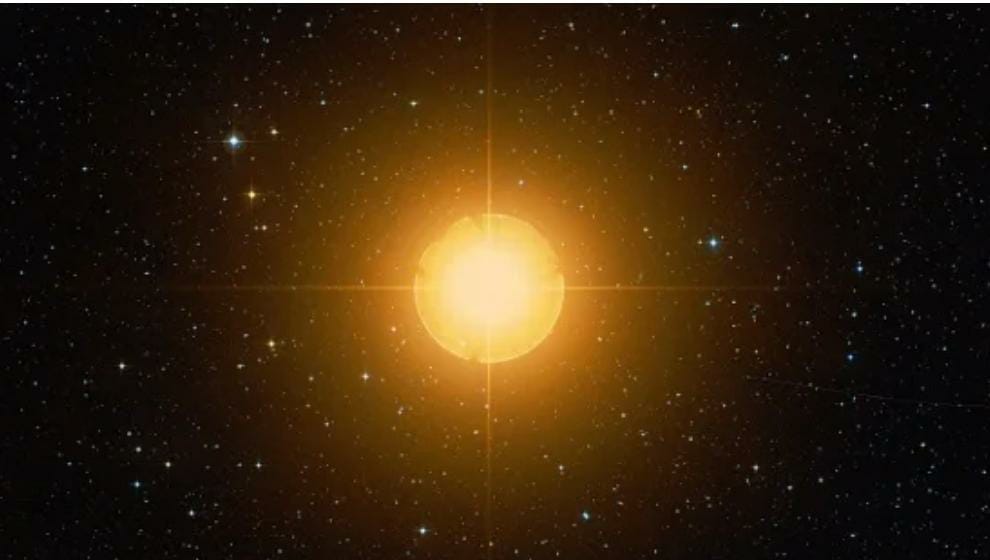
Alpard is also called as Alpha hydrae is a brightest star in the constellation of Hydra, the water snake. It lies at a distance of 177 light year from sun.
Alphard is a orange giant or bright giant star larger than our Sun, yet is cooler and more luminous.
Alphard star
Alphard is located in the constellation Hydra. Hydra is the largest of all 88 constellations, occupying 1,303 square degrees of the southern sky.
Alphard has the stellar classification K3 II-III, indicating a giant (III) or bright giant (II) appearing orange colour. The star has a mass 3.03 times that of the sun and has expanded to a size of 50.5 solar radii. With an effective temperature of 4,120 K, it is about 780 times more luminous than the Sun. It has a projected rotational velocity of 1.1 km/s and completes a rotation every 2,991 days. The star's estimated age is about 420 million years.
Astronomers have measured the chemical composition of Alphard's surface layers. Among other things, they have found high level of barium.
•Alphard appears on the flag of Brazil, symbolising the state of Mato Grosso do Sul.

•The Toyota Alphard is a minivan named after this star.
Many of us have been hearing or seeing in our everyday lives that our planet Earth has only one sunset. I am telling ‘only’ because their is a planet name HD 188753AB which has 3 sunsets or triple sunsets.
That yellow dwarf is HD 188753A, an orange dwarf is HD 188753B, a red dwarf is HD 188753C.
HD 188753 is a triple star system located approximately 149 light-years away from Earth in the constellation of Cygnus, the swam. The system is composed of HD 188753A, a yellow dwarf; HD 188753B, an orange dwarf; and HD 188753C, a red dwarf.

The primary star(HD 188753A) is like our Sun, weighing 1.06 solarmasses.  The other two stars(HD 188753B and HD 188753C) form a tightly bound pair, which is separated from the primary by approximately the Sun-Saturn distance.

The suns' colors(yellow) and sizes reflect their masses, temperatures and distances to the planet. The second star is farther away, less massive and cooler than the first, appearing smaller and yellow. The final star is at the same distance as the second, but it is still less massive and cooler, appearing even smaller and orange-red in color. Our Sun is a bit cooler than the hottest star of the system.

They orbit the primary with a period of about 25.7 years and an orbital eccentricity of about 0.50. The periastron distance of this orbit is 6.2 AU.
A yellow dwarf that completes each orbit in only 3.3 days. The main star is orbited every 25.7 years by two dwarfs revolving around each other (one is orange and another is red). The oribiting dwarfs are locked in a 156 days orbit. And each star sinking into the horizon and bouncing so much light off the planet darkness approaches the moon slowly.
×××××
Thank you reading my blog, meet you in the next blog.
Many of might be thinking that Sirius is only a single star. But in reality it is binary stellar system divided by name Sirius A and Sirius B.
So talking about both the star’s their orbits are around a common gravity center at a distance of about 20 AU(Astronomical unit).
Comparing to our solar system it is only one AU more than the distances between the Sun and Uranus of our solar system.
The orbitary period around the gravity center is about 50 year’s.
The tiny little star is Sirius B and the brighter large star is Sirius A.
Well, January and February are the perfect months to observe Sirius in both Northern and Southern hemisphere.
Sirius A
Sirius A is the brightest star in Earth’s night sky. It is also called the Dog star or Alpha Canis Majoris or simply known as Sirius.
Many of you might be thinking why it is called dog star? Well, Because it’s the chief star in the constellation Canis Major.
Have you ever heard about dog days of summer, so during January and February when Sirius is observed those days are known as dog days of summer.
Its name is derived from the Greek word ‘Seirios’ means glowing or scorching.
Sirius star was first reported by the German Astronomer ‘Friedrich Wilhelm Bessel’ in 1844. He had observed that the brightest star and lighter star neighbours were revolving around a common center and concluded that is companion star.
Sirius is so bright that it is well know since ancient and was name differently in many places. Sirius can easily be seen through our naked eyes.
The star is 8.6 light year’s away from our solar system and it’s brightness is 25 times as intense as that of the Sun. Sirius A temperature is 9940 K(Kelvin). It has high level of iron in atmosphere which is 316% as abundant as on Sun. Also heavier elements other than He(helium) was found. It is enriched with metallic elements.
Talking about future evolution it will probably continue to exist as it is for another 600 million year’s and after which it will turn into red giant and then a white drawf.
Observed normally from earth.
To find Sirius, use the belt of Orion as a pointer. The belt’s three stars point downward toward Sirius to the left.
Sirius B
A faint object now known as Sirius B, about 10,000 times fainter than Sirius A or 500 times fainter than the Sun.
After 18 year’s later, the companion was first seen in Jan 1862 by Alban Graham Clark, an American Astronomer and telescope observed Sirius B in the sky and told that Bessel observation was true.
Scientists believed that before becoming white drawf the star likely to have completed the two stages like ‘main sequence stage’ and ‘red giant stage’.
Scientists also believed that the process of turning into white drawf took place approximately across 120 million year’s ago and the mass used to be 5 times that of the Sun.
Sirius B temperature is 25200K. It has no internal heat source, it will gradually cool off and will eventually become a hypothetical black drawf in over 2 billions years time.
Sirius B is 10,000-times dimmer than Sirius. It’s so dim, and therefore so difficult to see from Earth. It was not easily observed so it was ignored for a very long time and finally in 2005 Scientists received a clear image with the help of Hubble telescope, both the star’s was visible.
Sirius B
They found that the star has a mass that is 98 percent that of Earth’s sun. Its volume is less than 1 million of that of the Sun.
In April, 2018, NASA launched the Transiting Exoplanet Survey Satellite (TESS), with the aim of finding exoplanets orbiting bright stars. Because Sirius is a young star, it’s not likely to have planets orbiting it. Nonetheless, the data TESS collects can be used to study variabilities in star brightness and the appearance of supernovas.


 Lucky's Creativity